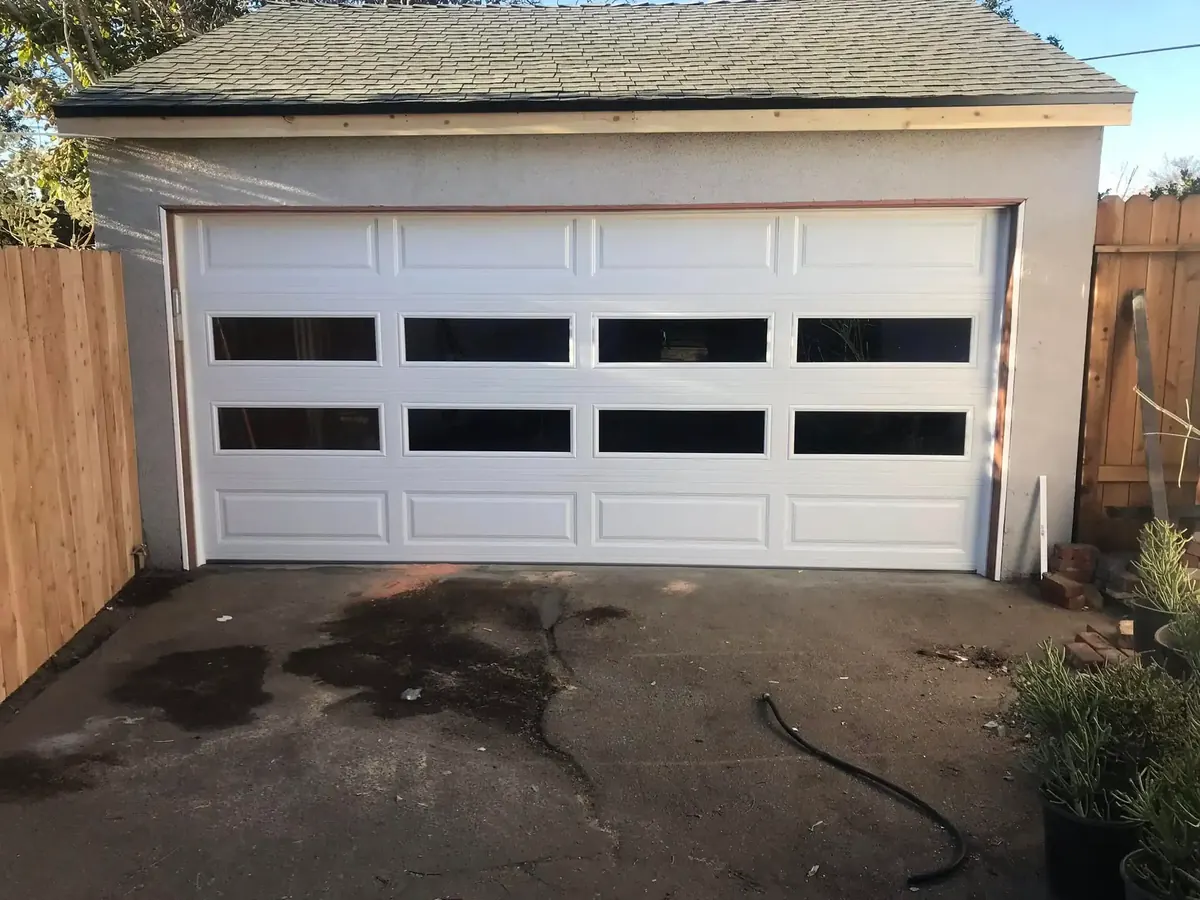
An emergency garage door problem is one that puts a person, a car or your property at risk right now. A door that will not close leaves a home open. A door that will not open can trap a vehicle or block the way to work. A door that has fallen off its track can drop without warning.
This page explains how to judge whether your situation is an emergency, what you can safely do while you wait, and what mistakes to avoid. It also explains how emergency pricing works in general and what we need from you on the phone.
What counts as a garage door emergency
Some situations are clear. Others take a moment to think through. Here are the common ones.
The door is stuck open
The door will not come down, or it will come down partway and stop. Your garage and often your home are open to anyone. This is a security emergency, especially at night or when you are leaving the house. It is also a weather problem when rain or wind is coming.
The door is stuck closed
The door will not go up. A car may be inside. You may need the vehicle for work, a medical appointment or a school run. If the garage is the main entrance to the home, you may also have an access problem.
The door is off its track
One or more rollers have popped out. The door hangs at an angle. The panels may be bent. This is one of the most dangerous conditions because the door can fall or twist. Do not try to force it back into place.
A spring has broken
A loud bang from the garage is the classic sign. The door will feel very heavy or will not lift at all. The opener may hum or strain. See the spring repair page for details.
A cable has snapped or slipped
One side of the door drops. The door may look crooked. The remaining cable and track are under extra stress. See cable and roller repair.
A vehicle or object has hit the door
A car backing into the door can bend panels, break rollers and push the tracks out of line. Even if the door still moves, the damage may be more than it looks.
The opener failed during a power outage
Newer openers should have a battery backup, as California requires for residential openers sold or installed since July 1, 2019. If the backup is drained or missing, the door may not respond. In that case the manual release is your way out. Details are below.
You cannot secure the property
If the door is damaged and cannot be locked, you may be at risk of a break-in. That is an emergency in its own right even if the door is mechanically stable.
What to do first: a safe checklist
Follow these steps in order. They are safe for most homeowners and take only a few minutes.
- Stay clear of the door's path. Keep people, pets and children away from the opening. A stressed door can move suddenly.
- Stop pressing the wall button and remote. Repeated presses can strip the opener gear or bend a track.
- Look and listen. Note where the door is stuck, whether it is level, and whether any cable, spring or roller looks out of place. Do not touch them.
- Check the simple things. Power to the opener, remote batteries, the wall control lock setting and the sensor lights.
- Call us. Call (424) 610-8406 and describe what you saw.
- Wait for the technician. Do not try a home fix on a spring, cable or bracket.
How to use the manual release safely
Every automatic opener has a red cord with a handle. Pulling it disconnects the door from the motor. This lets you raise or lower the door by hand. It is meant for power outages and opener failures. It is not a fix for a broken spring.
When it is safe
- The door is fully closed and you believe the springs and cables are intact.
- The door does not look crooked and no cable is loose.
- You are not lifting a door that feels far heavier than usual.
Steps
- Close the door if it is partly open and can be safely lowered.
- Pull the red cord straight down and slightly toward the door. The trolley should release.
- Try lifting the door a few inches by hand. A balanced door lifts easily and stays where you leave it.
- If it feels heavy or tries to slam down, stop and lower it. The springs are likely broken.
- Raise the door fully and keep it open only if it stays up.
After you disconnect the opener, do not reconnect it until the door has been checked. The trolley will re-engage the next time the door travels to the carriage. A door that is still damaged can strain the opener when it does.
If the door is stuck open and you cannot lower it
Your priority is to keep the property secure until a technician arrives. Here are practical steps.
- If the door can be lowered by the manual release and it holds, close it and lock the interior entry door.
- If it cannot be lowered safely, leave it as is and block the opening from the inside if you can do so without standing under the door.
- Move valuables, bikes and tools out of view if it is safe to reach them.
- If you are leaving, ask a neighbor or family member to watch the property.
Do not prop the door with a ladder or a piece of wood across the track. A door that shifts can crush the support and fall.
If the door is stuck closed with a vehicle inside
This is stressful, but the rule is the same. Do not force it. If the opener has failed but the springs are fine, the manual release usually lets you open the door. If the door will not rise by hand, the spring is probably broken. In that case call us. We can explain what to expect and whether the door may be lifted safely by two people while the repair is made. Do not attempt it unless we agree it is safe.
If you are trapped inside a garage with a door that will not open, use the interior release cord. If you still cannot get out, use the interior entry door to the house or call emergency services.
What to tell us when you call
A quick, accurate description lets us prepare parts and plan the visit. When you call (424) 610-8406, have this ready.
- Your address and your ZIP code.
- Whether the door is stuck open or closed, and whether it is crooked.
- What you heard, such as a bang, a scrape or a pop.
- Whether there is a vehicle or valuables inside.
- The size of the door, single or double, if you know it.
- The opener brand, if you can read it on the unit.
- Any access issues, such as an alley entry, a gate or a locked interior door.
Photos are helpful. If you can take a picture from a safe distance, keep it for the technician. Do not stand under the door to get the shot.
How emergency repairs are priced
Emergency pricing is a fair question. Prices depend on what has failed, not only on the time of day. Published guides note that some garage door professionals add a surcharge for late-night emergency calls. The exact number varies between companies. We do not list prices on this site. You get a free written quote after we see the door, and you approve it before work starts.
The main factors are these.
- The failed part. A spring, a cable and a roller have different costs.
- The door size and weight. A heavy or double door needs stronger parts.
- Related damage. A cable failure may have bent a track. Impact damage may involve panels.
- Access. A tight alley, a low ceiling or a locked space can add time.
- Time of day. Some companies charge more outside normal hours.
For background on published price ranges, see the cost guide.
Availability: what we can and cannot promise
This website does not promise a set arrival time. That would be misleading. Availability depends on the day, the schedule and the job. What we can promise is that when you call (424) 610-8406, we will tell you plainly what is possible for your address. If we cannot get to you soon, we will say so and help you make the door as safe as you can while you wait.
After the emergency repair
Once the door is running again, ask three questions.
- What failed, and why? A broken spring may be the result of age. A snapped cable may be the result of rust. Knowing the cause helps you prevent the next failure.
- What else is worn? Springs are often replaced in pairs. Rollers, hinges and cables may be near the end of their life.
- What should I do differently? A maintenance schedule, a new seal or a lubrication routine can help. See our maintenance page.
If the door is very old, an emergency can be a good moment to consider replacement. We explain the trade-offs on the installation and replacement page.
Emergencies in Santa Monica homes and buildings
Garage doors in Santa Monica have a few local quirks that matter in an emergency.
Alley and rear-access garages
Many garages stand behind the house and open onto an alley. If a door fails there, tell us about parking and access. A narrow alley can limit where a technician can set up.
Shared and underground garages
In apartments and condos, a single failed door can trap many residents. Managers should tell us how many doors and gates are affected and whether an entry override exists. The commercial repair page explains how these buildings differ.
Storm, wind and power outages
Wind and power outages can leave an opener without power. If your opener is older than July 2019, it may not have a battery backup. Know where your release cord is and keep the path clear.
Coastal wear
Salt and moisture rust springs and cables. A part that looks fine may fail without warning. If you live near the beach, ask about the age and condition of your hardware during any visit.
Preventing the next emergency
Most emergencies have warning signs. A spring that is near the end of its cycle life will often show a gap in its coil or a stiff door. A frayed cable shows broken strands. A worn roller squeals. A misaligned sensor blinks. If you catch these early, a planned repair replaces an emergency call.
- Test the balance twice a year by disconnecting the opener with the door closed and raising it halfway. It should hold.
- Look at the cables and springs for fraying, rust and gaps.
- Clean the sensor lenses and check their lights.
- Lubricate the hinges, rollers and springs with a product made for garage doors.
- Replace remote and keypad batteries yearly.
Three real-world scenarios
Every emergency looks a little different. These examples show how the guidance above applies. They are illustrations, not customer stories.
Scenario one: the bang before work
You press the remote in the morning. The opener hums, the door lifts a few inches and stops. You heard a loud noise from the garage the evening before. This points to a broken torsion spring. Stop pressing the button, leave the door alone and call. Do not lift the door. If the car has to come out today, tell us so we can talk through your options.
Scenario two: the power outage
The power goes out after a storm. The door is closed and the car is inside. Your opener is several years old. Check whether the battery backup, if any, responds. If it does not, pull the red cord with the door closed and try lifting the door a few inches. If it lifts easily and stays up, raise it fully. If it feels heavy, stop. That is a spring problem, not a power problem.
Scenario three: the rolled-back panel
Someone backs a car into the lower panel. The door still moves, but it shakes, scrapes and leans. Do not keep using it. A bent panel and a shifted track make the door unbalanced. Continued use can pop a roller and cause the door to drop. Take photos from a safe distance, avoid the door's path and call. If the damage came from a vehicle, keep the photos for your insurer.
Emergency guidance for property managers and landlords
When one garage door serves many people, an emergency affects the whole building. These steps help you respond quickly.
- Post a notice. Tell residents not to use or force the door. A simple sign at the control panel helps.
- Identify the failure. Note whether it is a door, a gate, an opener or an access control fault.
- Keep the building secure. If the door cannot close, arrange temporary security until it is repaired.
- Record the damage. Photos and notes support insurance claims and owner reports.
- Tell us how many doors and gates are affected. This helps us plan parts and time.
- Ask for a written quote. You may need it to authorize the work with an owner or board.
For ongoing service of multi-unit properties, see the commercial repair page.
What we check after an emergency repair
Fixing the part that failed is only half the job. A failed part often leaves stress on everything around it. Before we finish, we look at the whole system.
- Balance. We raise the door halfway to see if it holds. A door that drifts is not yet balanced.
- Tracks. We check for bends, gaps and loose mounting brackets.
- Cables and drums. We look for fraying, kinks and proper winding.
- Rollers and hinges. We check for wear, cracks and play.
- Opener travel and force. We confirm the limits and force are set correctly.
- Safety reversal and sensors. We test them again after the repair.
If we see something else that needs attention, we tell you and quote it separately. You decide whether to do it now or later.
Frequently asked questions about emergency garage door repair
What should I do if my garage door falls off its track?
What if my garage door is stuck open at night?
How do I get my car out of a garage with a stuck door?
Why did I hear a loud bang in my garage?
Is it safe to keep using my garage door after a car hit it?
Do emergency garage door repairs cost more?
Can I still use the opener after a power outage?
Do you promise a specific arrival time?
Garage door stuck or unsafe?
Call now and describe what happened. We will ask about emergency availability for your address and explain the safest steps while you wait.
Call (424) 610-8406