Springs get the attention, but tracks, cables and rollers do the guiding. They keep the door in line as it moves and they carry its weight as the springs turn. When any one of them fails, the door moves badly or not at all.
These parts are also the ones that suffer when a door is hit, when a spring fails or when the door goes years without care. Fortunately, most track, cable and roller problems are fixable without replacing the door. This page explains how each part works, what failure looks like, what you can safely check, and how we make the repair.
What tracks, cables and rollers do
Tracks
Steel tracks run vertically up both sides of the door and then curve to run horizontally along the ceiling. They act as rails. The door's rollers ride inside them. Tracks must be straight, parallel and firmly mounted. If they lean, twist or loosen, the door binds. Most residential doors use tracks two inches wide, and some heavier doors use three-inch tracks. The width has to match the roller stems.
Rollers
A roller is a small wheel on a stem fitted through a hinge. Rollers can be steel or nylon. Steel rollers are tough and common. Nylon rollers are quieter and often have sealed bearings. The number of ball bearings varies. More bearings usually means smoother, quieter travel. Rollers wear out over time, and a worn roller can wobble, crack or jump out of the track.
Cables and drums
On a torsion system, a steel cable runs from a bracket at each bottom corner of the door up to a drum at the end of the spring shaft. The drum winds the cable as the door rises. The cable carries the door's weight. Under load it is a serious piece of hardware.
Extension spring systems use cables and pulleys that run along the tracks. They serve as the lifting line and, in some designs, as the safety line.
Hinges
Hinges join the panels and hold the rollers. A cracked or loose hinge lets the door flex and can pull a roller out of line. Hinges are numbered by gauge and position, so the right one is needed in each spot.
Signs your door has a track, cable or roller problem
Off track
- One or more rollers have popped out of the track.
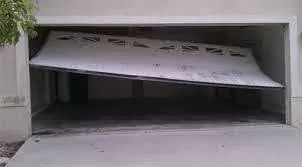
- The door hangs at a slant.
- A gap has opened between the door and the track.
- The door jams partway up or down.
- The panels look bent or twisted.
Cable trouble
- A cable is slack, hanging or off the drum.
- Broken strands show along a cable, especially near the bottom bracket.
- One side of the door sits lower than the other.
- Rust or a kink has formed in the cable.
- The cable makes a loud snap when the door moves.
Roller and hinge trouble
- Squealing, grinding or rattling noises as the door moves.
- A door that shakes or vibrates.
- Rollers that are cracked, flat or loose in the hinge.
- Hinges that are bent or have cracks at the stem.
Track trouble
- A visible bend, dent or kink in the track.
- Gaps where the vertical and horizontal sections meet.
- Loose track brackets that let the track wobble.
- The door binds at the same spot each time.
Why these parts fail
Impact
A car that bumps the door, a heavy object that hits it or a door slammed by wind can bend a track or crack a hinge. Even a small impact can push a track out of line.
A broken spring
When a spring breaks, the door suddenly loses its main support. The cables jerk, the door tilts and rollers may jump. A cable that was already frayed may snap. That is why we inspect all these parts after a spring failure.
Lack of lubrication and cleaning
Dry rollers and hinges wear. Dirt in the tracks makes rollers skid. Both make noise and speed up wear.
Rust and corrosion
Salt and moisture near the coast rust cable ends, bottom brackets and track fasteners. Bottom brackets and cables carry the highest tension, so rust here is not just cosmetic. It weakens the very parts that hold the door.
Loose fasteners
Vibration loosens bolts over time. Track brackets that work loose let the track drift out of alignment.
Age
Rollers, hinges and cables are all wear items. Eventually they need replacing even on a well-cared-for door.
Safety: what not to do
- Do not try to reset a roller by hand when the door is partly open.
- Do not stand under a crooked or hanging door.
- Do not use the opener on a door that is off track.
- Do not tape, wire or prop a broken cable.
- Do not hammer a bent track straight without support. A partial fix can leave the door unsafe.
Safe checks include looking at the parts from a distance, noting the noise and the position of the door, and photographing anything unusual. Then call (424) 610-8406.
How we repair a door that is off track
- Secure the door. We make sure it cannot fall while we work.
- Find the cause. A door does not leave its track without a reason. We look for a broken cable, a broken roller, a bent track or a bent panel.
- Release tension when needed. On torsion doors we relieve spring tension properly before working on a cable or bottom bracket.
- Repair or replace the damaged parts. Depending on the damage, we straighten or replace the track, replace the rollers and hinges, and restring the cable.
- Realign the track. We check that the vertical tracks are plumb, parallel and correctly spaced from the door. We check the horizontal tracks for level and proper pitch.
- Re-seat the door. We put the rollers back in the tracks and check the travel.
- Balance and test. We recheck the balance and the opener's limits.
Some damage is too severe to repair. A door whose panels are creased or torn may need a section replaced. See installation and replacement.
How we repair a broken or slipped cable
A cable can fail in two ways. It can snap, or it can slip off its drum. Both leave the door hanging on one side.
- Inspect both cables. If one has failed, the other has done more work and may be worn.
- Relieve spring tension safely. This protects everyone in the garage.
- Remove the old cable. We free it from the bottom bracket and the drum.
- Check the drum. A damaged drum groove can cut a new cable. We replace drums if needed.
- Fit the new cable. It must be the right length and seated correctly in the drum.
- Restore the tension. We rewind the spring to the correct number of turns.
- Check the balance. Both sides must lift evenly.
Many technicians replace both cables at the same time, since they wear together. We give you the option and explain the reason.
Roller replacement
Rollers are one of the least expensive parts on the door and one of the most useful to replace. Fresh rollers can transform a noisy, shaky door into a quiet one.
Choosing a roller
| Roller type | Pros | Cons |
|---|---|---|
| Basic steel | Low cost, strong | Louder, wears faster without lubrication |
| Steel with sealed bearings | Smoother, longer life | Costs more |
| Nylon with bearings | Quiet, smooth | Can wear or crack if the door is heavy or dry |
The right roller depends on the door's weight, the track size and how quiet you want the door. If the garage sits under a bedroom, quiet rollers are worth the extra cost. If the door is very heavy, a strong steel or sealed steel roller may be better.
Replacing the hinges
Roller stems pass through hinges. We usually inspect hinges when we replace rollers. Cracked or bent hinges are replaced. The end hinges hold the most load, so they are often the first to fail.
Track repair and replacement
Tracks are simple but must be precise. A track that is out by even a small amount can cause a door to bind or jump.
When a track can be repaired
- A minor bend that can be safely straightened.
- Loose brackets that need tightening or replacing.
- Small misalignments that can be corrected by shifting the track.
When a track must be replaced
- A kink or crease that cannot be safely straightened.
- A section that has torn away from its mounting.
- Rusted or thinned steel.
We check both sides and the horizontal sections. A bent track on one side may be a sign that the other has shifted too.
What repairs cost: published ranges
We give a free written quote after we see the door. To help you plan, here are ranges published in 2026 cost guides. They are not our quotes and vary by door and location.
- A HomeGuide Santa Monica page lists cable repair at $80 to $185.
- A July 2026 Los Angeles cost guide from a local company lists cable repair at $100 to $250, roller replacement at $100 to $200 and track realignment or replacement at $125 to $400.
- The same guide lists replacing a single panel at $250 to $800, depending on size and style.
Parts, door weight, damage and access all affect price. For more detail see the cost guide.
Noise diagnosis: what your door is telling you
Different sounds point to different problems.
| Sound | Likely cause |
|---|---|
| Squealing or squeaking | Dry hinges, rollers or spring coils |
| Grinding | Worn rollers or a bent track |
| Rattling or clanking | Loose hardware or a loose track bracket |
| Popping | Spring coils, or a roller catching in the track |
| Scraping | Panel rubbing the track or frame |
| Loud slap or bang | Spring or cable failure |
A quick lubrication may cure the squeal. Grinding and scraping need inspection.
Track, cable and roller repair in Santa Monica
Coastal air and rust
Steel tracks, cable ends and bottom brackets near the coast tend to rust faster. Rust on the bottom brackets and cable ends deserves attention because these parts carry the highest load. When we replace a cable or bracket, we can discuss corrosion-resistant hardware.
Tight alleys and low clearances
Many garages in Santa Monica open onto alleys or sit beside fences. A vehicle backing out can clip the door or track. Consider bollards or guides if this happens often.
Garage conversions and framing changes
If a garage has been converted, reframed or fitted with new walls, tracks may need to be re-hung. Wall framing that shifts can change track spacing. Tell us if the structure around the door has changed.
Older doors
Older doors may use track and hardware that are no longer common. We do our best to match parts or explain the alternatives.
Keeping tracks, cables and rollers healthy
- Wipe the inside of the tracks with a clean, dry cloth twice a year. Do not grease the tracks.
- Lubricate rollers, hinges and spring coils with a garage door lubricant.
- Look at cables for broken strands and rust.
- Check that the track brackets are tight and the tracks are level.
- Keep vehicles and bikes from touching the door.
- Replace rollers and hinges as part of a periodic refresh.
For a full schedule see garage door maintenance.
Reading the door: a look at the whole system
A tilting or noisy door is rarely a one-part problem. The symptoms give clues, but the cause can sit somewhere else. Here is how technicians think about it.
If one side is lower than the other
Most often, a cable has slipped or broken on the low side, or the spring on that side is weaker. A bent track or a broken roller can also let a corner drop. The fix depends on which part failed.
If the door jams in the same spot
A dent in the track, a bent hinge, or a roller that is catching on a joint between track sections is likely. We check the spot closely and often find a small defect that causes a big jam.
If the door is noisy all the way
Worn rollers and dry hinges are the usual cause. If the noise is a slow scrape, look for a panel rubbing on the track or the frame.
If the door falls when released halfway
The balance is off. This is a spring issue, not a track issue. See spring repair.
If the door is stuck open
Look for a cable off the drum, a roller out of the track or a sensor blocking the close. The door may be safe to lower slowly with the release cord, but only if it is not crooked. If in doubt, leave it.
If the opener strains
The opener is fighting drag from the door. Rollers, hinges and track alignment are the first things to check.
Why a small track problem matters
A door that rubs a track looks like a minor annoyance. Over time it becomes a bigger issue.
- Friction wears rollers and hinges faster.
- The opener works harder and wears out sooner.
- The springs lose their balance as the door drags.
- A panel can crack where it rubs.
- Eventually a roller pops out and the door drops.
Fixing a small track issue early avoids all of these. It usually costs less than a single emergency call.
Tools and hardware that should be left to a technician
Some of the work in this area needs special tools and training. That is why we do not recommend DIY on the following.
- Winding bars and winding cones. Used to set and release spring tension. They must fit exactly.
- Bottom bracket bolts. Under load from the cable and the door weight.
- Cable drums and set screws. Must be tightened to the right torque and position.
- Track mounting. Must be square, level and plumb to the door.
- Center bearing and end bearing plates. Support the torsion shaft.
The tools are cheap to buy. What they need is training. A slipped winding bar can strike the person holding it.
What to have ready when you call
- A short description of what the door is doing and when it started.
- Whether the door is stuck open, stuck closed or partly open.
- Which side is low, if the door is crooked.
- Any noises you heard just before the problem.
- Whether a vehicle or object struck the door.
- Photos taken from a safe distance.
- The door size and material, if you know them.
That lets us plan for the right tracks, cables, rollers and hinges before we arrive.
When repair is not enough
Some door damage goes past what a track or cable repair can fix. If panels are creased along the seams, if the frame has pulled away or if the door has been off track several times, replacement may be the safer choice. We tell you plainly when that is the case and quote both options.
Frequently asked questions about off-track doors, cables and rollers
What should I do if my garage door comes off its track?
Can I put a garage door back on its track myself?
Why did my garage door cable snap?
Should I replace both cables at once?
Why is my garage door so noisy?
How much does it cost to fix a bent garage door track?
Can a damaged panel be repaired instead of replaced?
How often should garage door rollers be replaced?
Door crooked, cable slack or track bent?
Stay clear of the door and call. Describe what you see and we will give you a free written quote for the repair.
Call (424) 610-8406